Ingredients:
2 medium yellow whole onions, cut in half, skin removed
1 large ginger knuckle or finger, or 2 medium.
5-10 pounds beef soup bones -- shin, leg, and knuckle bones, preferably with marrow -- not neck or tail bones. Cut into pieces about 3" - 4" long.
4 - 6 star anise
4 - 6 whole cloves
2 pieces of asian cinnamon stick (or 4" Mexican, in extremis)
1 pound beef stewing meat cut into 2" x 2" cube pieces. Beef brisket is good.
1-1/2 tablespoons salt or Hawaiian rock sea salt, even kosher salt is good.
5-10 tablespoons fish sauce or nuoc mam or patis to taste.
1 1-inch chunk yellow rock sugar, or 2 tbs granulated white sugar. Brown cane sugar can be used too.
Yield, about 5-6 quarts.
Procedure:
Broil the onion and ginger over a flame or on the electric burner. Blacken the onion and ginger but do not burn it. You are going after the charred flavor. Rinse under running water to get rid of all the loose blackened skin particles. Set aside to cool.
Soak your bones in cold water first in the pot to release the blood about 1-2 hrs or so. Drain and rinse the bones then refill the pot with fresh water and add the bones back. Parboil the bones.
Turn on the hot water sink tap. Empty the bones and water into the sink. Allow water to go into the drain. Thorougly rinse the bones to get rid of any impurities that may have stuck to them. Set aside when clean. Thoroughly rinse the pot to get of any impurities that may have stuck to it. Return the bones to the pot, and cover with fresh, cool water. One to two times is good. You want a clean clear broth and this sets the standard.
Bring to the boil over high heat, reduce to a simmer. Allow to simmer for 10 minutes and skim the scum constantly.
Stuck the cloves into the round onions.
After the first skim, add the whole onions, ginger, anise, cloves, and cinnamon sticks to the stock. Check for scum at ten minute intervals, three times. Skim any scum that appears.
Beginning at the 1 hour mark, check the meat to see if it is tender (but not stringy). Check every 15 minutes thereafter. When the meat is cooked (usually about 90 minutes), remove it. Drain and immediately wrap (still hot) in aluminum foil. Reserve in the fridge, and use later as one of the pho meats.
Continue simmering stock. If water evaporates so bones become exposed, add more water as necessary. Stock should be finished at around 3 - 5 hours total simmer time (not counting the par-boil). Strain through a fine sieve. Check bones for any tendon which may have clung to them. If there is tendon, reserve in the same way as the cooked beef. Defat the stock if you like, but not too aggressively. Stock should be rich but not greasy.
All authentic Pho shops simmer their broths 6-10hrs or longer for a deep rich beefy broth. Some use spice and broth packets to speed up production but real old school shops use real fresh herbs and fresh bones daily. Their broth gets deep and and rich but super clear as they remove all fat from it.
For the bowls:
1 1/2-2 pounds small (1/8-inch wide) dried or fresh banh pho noodles ("rice sticks'' or Thaichantaboon)
1/2 pound raw eye of round, sirloin, London broil or tri-tip steak, thinly sliced across the grain (1/16 inch thick; freeze for 15 minutes to make it easier to slice)
1 medium yellow onion, sliced paper-thin, left to soak for 30 minutes in a bowl of cold water
3 or 4 scallions, green part only, cut into thin rings
1/3 cup chopped cilantro (ngo)
Ground black pepper
Garnishes arranged on a plate and placed at the table:
Sprigs of spearmint (hung lui) and Asian/Thai sweet basil (hung que)
Leaves of thorny culantro (ngo gai)
Bean sprouts (about 1/2 pound)
Red hot chiles (such as Thai bird or dragon), thinly sliced
Lime wedges
Assemble pho bowls:
The key is to be organized and have everything ready to go. Thinly slice cooked meat. For best results, make sure it's cold.
Heat the pho broth and ready the noodles. To ensure good timing, reheat broth over medium flame as you're assembling bowls. If you're using dried noodles, cover with hot tap water and soak 15-20 minutes, until softened and opaque white. Drain in colander. For fresh rice noodles, just untangle and briefly rinse in a colander with cold water.
Blanch noodles. Fill 3- or 4-quart saucepan with water and bring to boil. For each bowl, use long-handle strainer to blanch a portion of noodles. As soon as noodles have collapsed and lost their stiffness (10-20 seconds), pull strainer from water, letting water drain back into saucepan. Empty noodles into bowls. Noodles should occupy 1/4 to 1/3 of bowl; the latter is for noodle lovers, while the former is for those who prize broth.
If desired, after blanching noodles, blanch bean sprouts for 30 seconds in same saucepan. They should slightly wilt but retain some crunch. Drain and add to the garnish plate.
Add other ingredients. Place slices of cooked meat, raw meat and tendon (if using) atop noodles. (If your cooked meat is not at room temperature, blanch slices for few seconds in hot water from above.) Garnish with onion, scallion and chopped cilantro. Finish with black pepper.
Ladle in broth and serve. Bring broth to rolling boil. Check seasoning. Ladle broth into each bowl, distributing hot liquid evenly so as to cook raw beef and warm other ingredients. Serve your pho with with the garnish plate.
If you want authentic pho dac biet or combination pho served at pho shops, head to the chinatown butcher. There you'll find white cords of beef tendon and thin pieces of outside flank, not flank steak. Beef tendon which is actually "muscle" requires no preparation prior to cooking, Simmer it and the beef tendon in the cooking broth for 2-3 hours, or until soft chewy-tender.
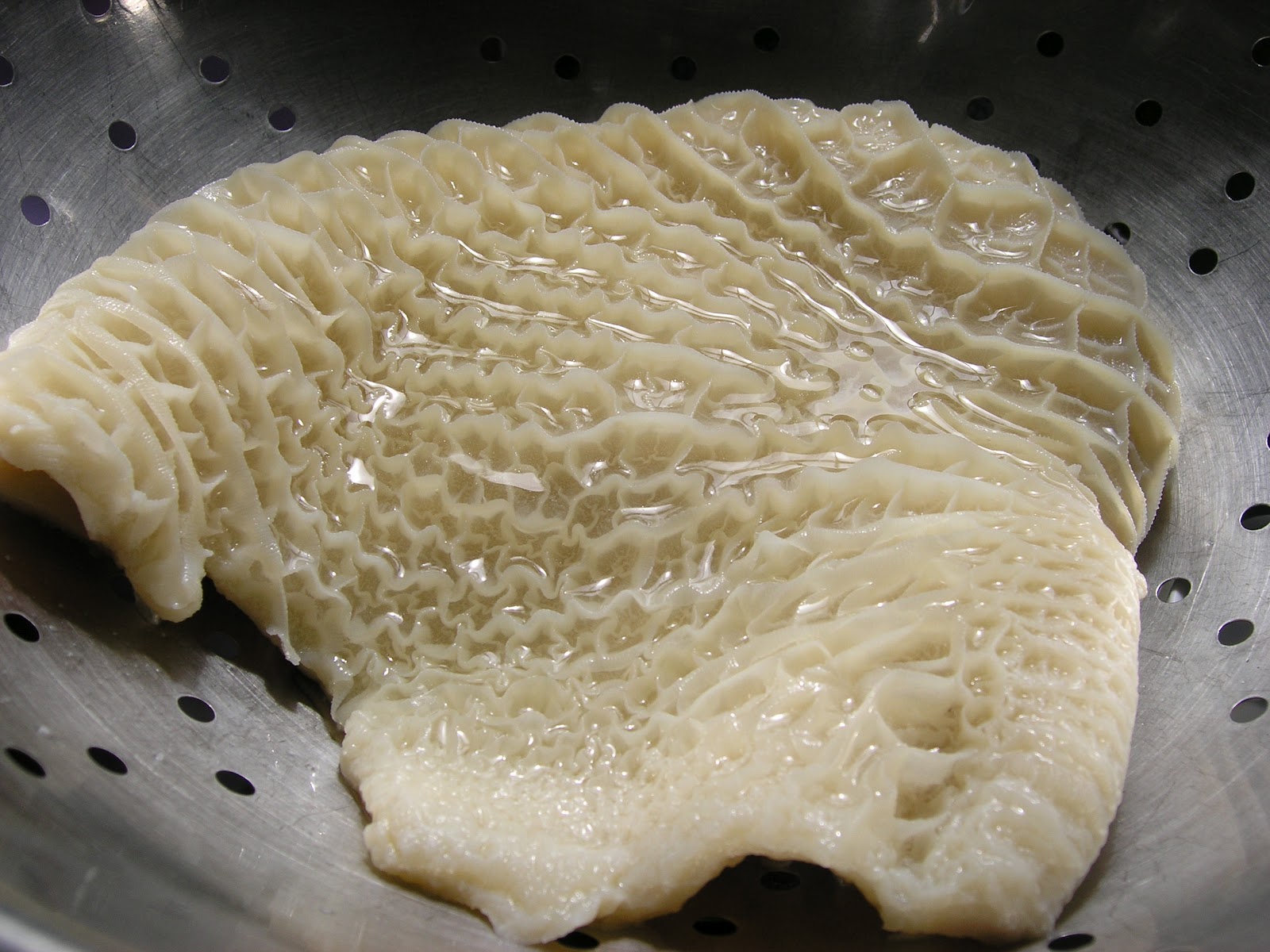
Book tripe needs to be boiled and rinsed to chewy tenderness before using, wash and gently squeeze it dry. Slice it thinly to make fringe-like pieces to be added to the bowl during assembly. For beef meatballs (bo vien), purchase them in asian markets in the refrigerator case; they are already precooked. Slice each one in half and drop into broth to heat through. When you're ready to serve, ladle them out with the broth to top each bowl.
 |
| garnish to add to your bowl of pho |
 |
| frozen bo vien |
 |
| bo vien or beef meatballs |
 |
| beef tendon |
 |
| book tripe |
Very time consuming to prepare but if you're doing it for loved ones than it's all worth it!!
Let's kaukau!! :D